I followed the Mandovi inland from Panaji to understand how Goa’s capital connects with its islands, villages and former trading centres. The river gave my journey a clear direction, linking places often treated as separate excursions.
My route covered the lower Mandovi, using roads and ferries rather than following every bend by boat. I spread it across two days, leaving enough time for the crossings and exploring between stops. That pace made the journey manageable without reducing each place to a photograph.
Panaji: getting to know Goa’s waterfront
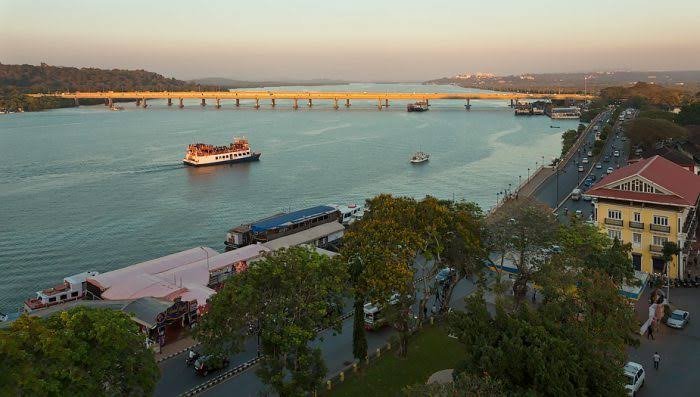
I started beside the river in Panaji, where the broad waterfront helped me get my bearings. Looking across towards the opposite bank made one practical point clear. Somewhere that appears close on a map may still require a bridge crossing or ferry journey.
For this route, I narrowed my search for hotels in Goa to Panaji and its surroundings. Staying near the capital made the early departure towards Ribandar easier and kept the return journey straightforward.
Across the river, Reis Magos Fort in Verem provided the historical context for my route. Its position overlooking the Mandovi explains why it once guarded the approach to Old Goa. I treated it as a separate detour rather than keeping it between island crossings. Check current opening arrangements before travelling, particularly on Mondays.
Goa’s Panaji: taking the ferry from Ribandar
I went to Ribandar to explore the Chorao ferry from Panaji. Since ferries make crossing the river routine, keeping the ferry boarding station free takes higher priority than getting a good picture angle. I built in extra time to enjoy the ferry ride instead of leaving soon. It is important to allocate some time to getting on the ferry in queues with your vehicle.
At the western edge of Chorao is the Dr Salim Ali Bird Sanctuary, an area of mangroves where the Mandovi River takes on another form. It is a region that can be appreciated for its little details like roots that come into the outdoors, muddy banks, and birds flying in the trees.
The first stop on my day was also the first stop. Early morning was a perfect time for birdwatching, but there are also tides to be taken into account when making a boat trip. I was again lucky to find that all the routes were open.
Binoculars, drinking water and insect repellent are worth carrying. I also recommend leaving time to listen to a guide explain the habitat, rather than focusing entirely on spotting birds.
Old Goa: approaching the former capital
On my second day, I followed the road through Ribandar towards Old Goa. Beginning near the river helped me understand the former capital before entering its better-known church precinct.
The Viceroy’s Arch served as my initiation point. Located at the historic river landing, it links the inland sites to where the populace arrived. That connection is not always apparent when you enter the main churches directly.
From that point, I proceeded toward St Cajetan’s Church; the Basilica of Bom Jesus and the Sé Cathedral may follow, depending on how long you spend inside. Dress in a respectful manner while visiting churches and see when services are going on. Be sure to bring water so that the hot walks between the buildings do not tire you too much.
Old Goa: crossing to Divar
I caught the ferry from Old Goa to Divar and rode through village lanes dotted with homes and farms. The ferry ride is a part of the adventure; make sure to have arrangements for your next transport ahead of time as you explore further.
The Church of Our Lady of Compassion in Piedade gives the village route a focus. The Divar shows how communities have adapted to the rivers, affecting their daily lives.
Panaji: Planning an Unhurried Goa Return
I left room for ferry queues on the return to Panaji. A tightly scheduled onward journey would have made the afternoon unnecessarily rushed.
When choosing hotels in Goa for this itinerary, I would again put location first. An easy return leaves more time for the river itself.